K-food, K-beauty, and other K-content are receiving worldwide acclaim. At the heart of this trend are our small and medium-sized enterprises (SMEs). In the first half of this year, SME exports reached $57.1 billion, a 4.4% increase compared to the same period last year, marking the highest record ever since statistics began. However, there is still a long way to go.
The high export dependence on specific items and stagnation in the number of exporting SMEs are raising concerns that, to continue the current Korean Wave boom on the global stage, there needs to be not only quantitative growth but also qualitative improvement.
On the 9th, a policy forum to explore ways to globalize SMEs was held as part of the ‘2024 SME Leaders Forum’ at the Haevichi Hotel in Jeju. More than 100 SME CEOs gathered to discuss various policy alternatives that would help expand SMEs’ economic territory in global markets. SME News introduces the key points discussed at the event.

“Our country’s GDP has grown nearly 700 times from $2.4 billion in 1962 to $1.673 trillion in 2022, but the dynamism of the economy is fading. Now, we must find a new growth model through globalization and innovation.”
At the ‘2024 SME Leaders Forum’ policy discussion held on the 9th at the Haevichi Hotel in Jeju, Professor Oh Dong-yoon from Dong-A University, who gave the keynote address, stated, “For sustainable growth, it’s time to focus on qualitative expansion, such as innovation and globalization, rather than just quantitative expansion. We need to increase the number of Born Global companies that push for globalization from the startup stage and build a global value chain that globalizes the entire supply chain of business management, from production to management activities, not just products.”
Professor Oh also noted, “In 1980, there were only 700,000 SMEs, but now in Korea, there are over 8 million. SMEs are the only dynamic sector in our country.”
He further emphasized, “The only remaining growth method for our economy, which has lost its dynamism, is for SMEs to go abroad, sell their products, and create healthy connections with workers and small businesses,” reiterating the importance of SME globalization.
Professor Oh also explained that collaboration across industries is essential for SME globalization. He said, “To globalize a product, if marketing is needed, SMEs should collaborate with marketing companies. If research and development (R&D) is needed, instead of setting up a research institute, they should partner with people who excel in R&D,” and emphasized that the SME Central Association, based on industry-specific cooperatives, should play a key role in facilitating such collaborations.
Three major global Korean organizations gathered in one place
After the keynote, a discussion was led by Lee Si-wook, President of the Institute for Global Economic Policy. The discussion panel included Choi Woo-gak, Vice President of the SME Central Association; Park Jong-beom, President of the World Federation of Korean Traders; Kim Woo-jae, President of the World Korean Business Conference; Ko Sang-gu, President of the World Korean Association; and Vu Ho, the Vietnamese Ambassador to Korea. It was noteworthy that the leaders of the three major Korean overseas organizations, who represent 7.5 million Koreans abroad, were all present. This is the first time the three leaders of these organizations have gathered to discuss the globalization of SMEs.
Choi Woo-gak, Vice President of the SME Central Association, stated, “Although exports of Korean products such as K-food and K-beauty have surged with the recent Korean Wave boom, more than 90% of small manufacturing businesses rely solely on the domestic market, which is a limitation. The push for SME globalization is not a choice but a necessity, so cooperative associations must work hard to train export professionals, discover successful models, and more,” he argued.
Park Jong-beom, President of the World Federation of Korean Traders, emphasized, “‘Made in Korea’ products are no longer seen as foreign products but as reliable choices,” and added, “Now is the perfect time for our SMEs to expand abroad.”
He then used the European market as an example, saying, “For successful entry, it’s crucial to establish trust-based local partnerships and strengthen cooperation with local businesses and institutions. These partnerships will help lower various barriers and create marketing strategies tailored to local conditions.”
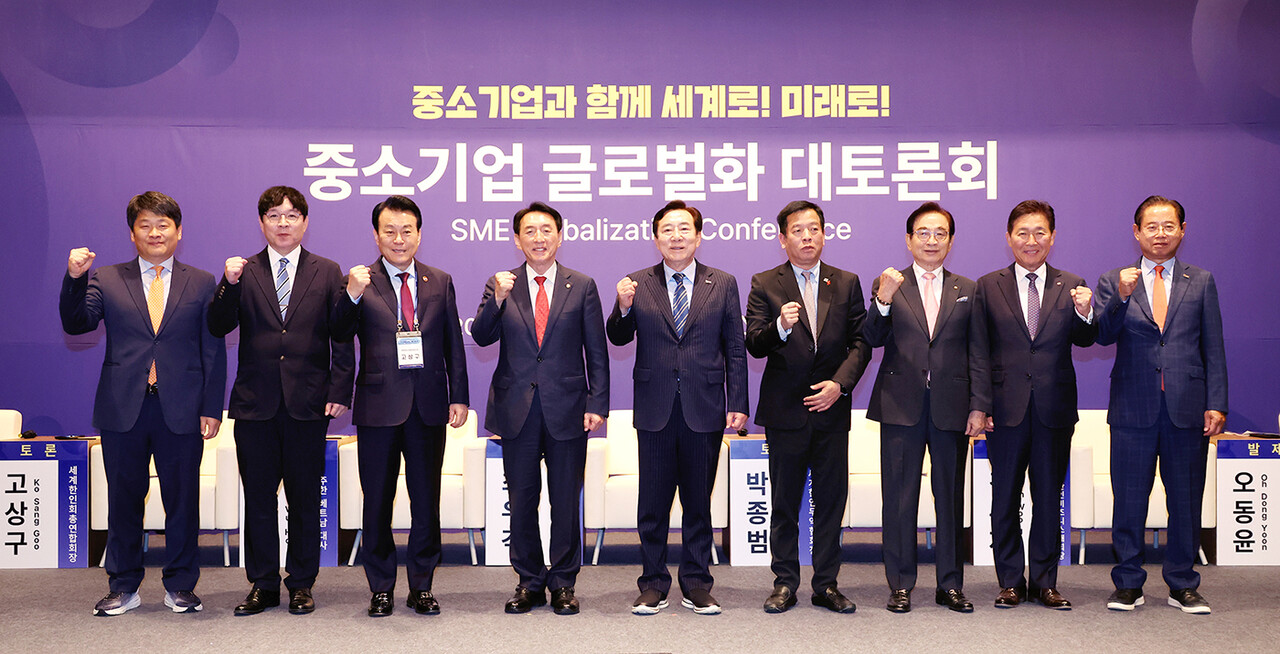
On the 9th, during the ‘2024 SME Leaders Forum’ held at the Haevichi Hotel in Jeju, attendees, including Kim Ki-moon, Chairman of the SME Central Association (center), posed for a commemorative photo. From left to right: Professor Oh Dong-yoon of Dong-A University, Lee Si-wook, President of the Institute for Global Economic Policy, Ko Sang-gu, President of the World Korean Association, Kim Seok-ki, Chairman of the National Assembly’s Foreign Affairs and Unification Committee, Kim Ki-moon, Chairman of the SME Central Association, Vu Ho, Vietnamese Ambassador to Korea, Kim Woo-jae, President of the 22nd Korean Business Conference, Park Jong-beom, President of the World Federation of Korean Traders, and Choi Woo-gak, Vice President of the SME Central Association. [Hwang Jung-ah, Reporter]
Vietnamese Ambassador suggests expanding investment between the two countries
Kim Woo-jae, President of the World Korean Business Conference, said, “Due to the recent global supply chain instability, Indonesia, a resource-rich and populous country, is emerging rapidly. With increasing complexity in economic and trade issues, there are more problems that individual companies and institutions find difficult to solve. Therefore, there is a growing need for a system that can protect the rights of our businesses and speak with one voice, especially regarding issues such as licensing and foreign investment-related regulations. Government-level support is needed,” he explained.
Ko Sang-gu, President of the World Korean Association, emphasized, “Compared to large corporations, SMEs inevitably face difficulties in communication with local businesses and governments or gathering information. Therefore, it’s essential to leverage the Korean network of 7.5 million overseas Koreans.”
He added, “Since the Overseas Koreans Agency was launched last year, the role of Koreans abroad will expand globally,” and promised, “As the overseas ambassador for the SME Central Association and President of the World Korean Association, I will help Korean SMEs expand overseas.”
Vietnamese Ambassador Vu Ho stated, “Korea and Vietnam have a close cooperative relationship in trade and investment, and with the visit of Vietnamese Prime Minister Pham Minh Chinh in August, SME cooperation between the two countries will be strengthened even more,” and suggested, “In the future, investment cooperation between the two countries should expand in new fields such as digital economy, green economy, semiconductors, and entertainment industries.”
Kim Ki-moon, Chairman of the SME Central Association, who chaired the forum, said, “While a variety of SME products, including K-beauty, K-food, stationery, accessories, and kitchenware, are selling like hotcakes overseas, many SMEs still stay in the domestic market because they lack specialized personnel and information about foreign markets, even though they produce good products.” He concluded, “I hope that the discussions held today will lead to various policy alternatives and solutions that can help SMEs expand their economic territory in the global market.”
Source: Kbiz News


